
Ai-lone
There’s this one sentence from Salma Alam-Naylor’s Blog Post that really fascinates me:
AI is an incredibly lonely experience where human collaboration and conversation have been replaced by strange conversations with computer algorithms.
That sentence hits the nail on the head for me — and it leaves behind a deep sadness. This loneliness at work started for me with the pandemic. And yes, I love working from home. Especially as a parent, it’s a blessing not to be away from home for eleven hours a day — to witness a lot, or even most, of your child growing up. When you’re trying to share parenting and partnership as equals, it also means the other parent can occasionally tap out and catch their breath.
At the same time, I find myself holding on to a work reality that was shaped by coding together, solving problems together — and yes, the occasional Nerf gun battle or foosball game was a welcome break for passively mulling over a bug, which back at your desk would often get solved pretty quickly. But even when it didn’t, there were always colleagues in the office who could help. Now, with AI being practically omnipresent, it somehow feels even worse. Even in the office, it has become quiet and lonely. And a sentence from a colleague describes that feeling just as perfectly as Salma did:
So I just discussed the best solution to the problem with my agent.
Where we used to ask a colleague, we now ask an agent — or even four, five sub-agents. Sure, that buys our colleague some time, sparing them from being pulled out of their context to deal with our problem. But what gets lost? Our own problem-solving skills. And the connection to our colleagues. That shared moment of triumph when the div is finally centered. The code works and the linter stops complaining.
Or simply that a colleague might not have an answer right away either. That you’re not alone in that brief moment of not knowing. That won’t happen with AI. It always has something to say — immediately, confidently, even when it’s wrong.
Ask a colleague again. Pull them out of their context. It’s worth it — for both of you.
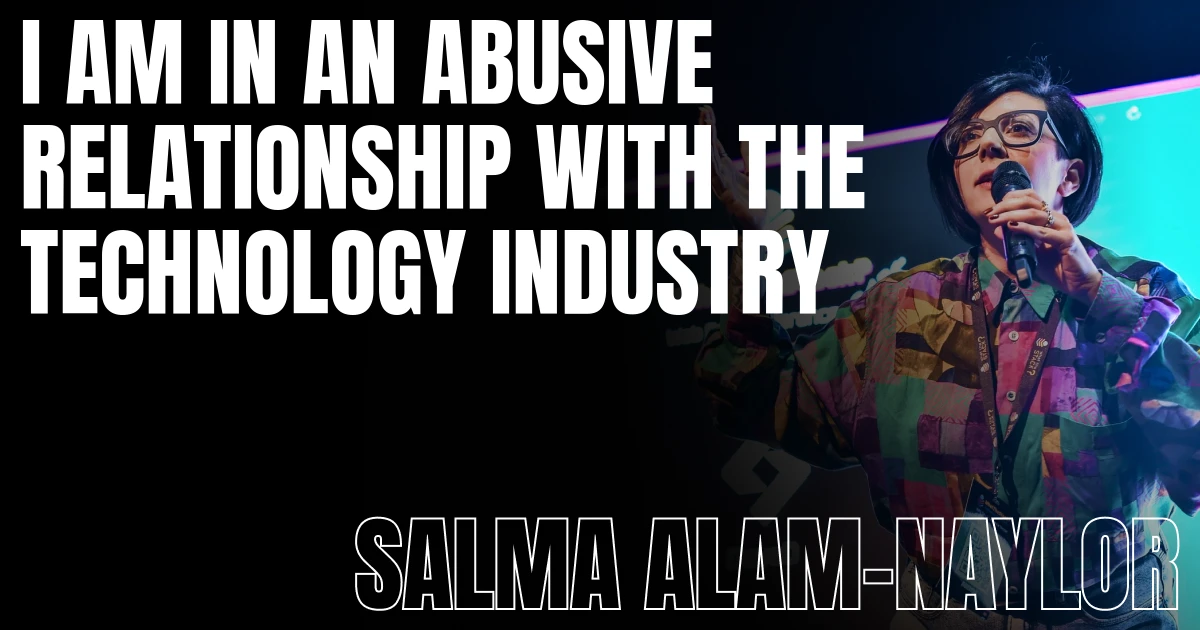
I am in an abusive relationship with the technology industry
I am writing to you in a moment of intense grief-induced burnout.Salma Alam-Naylor (whitep4nth3r.com)
like this
Joyce Donahue, Coaster, Jay Bryant, Andrew Pam and Michael Fenichel like this.
Lo, thar be cookies on this site to keep track of your login. By clicking 'okay', you are CONSENTING to this.
Michael Fenichel
in reply to Muse • • •Apropos (on the level of relating with humans rather than....) though not specific to AI & sub-agents. Vintage. Pithy.
But from a #psychology / #behavior perspective, IMM it's related. Like talking with Alexa or Siri, or AliceBot, or 'social media' - but more likely to be insidious, or harmful when people are manipulated, and even addicted to an AI "friend".
Author, composer and computer scientist Jaron Lanier has been an opponent of privacy invasion and data-mining as a business model._
... show moreApropos (on the level of relating with humans rather than....) though not specific to AI & sub-agents. Vintage. Pithy.
But from a #psychology / #behavior perspective, IMM it's related. Like talking with Alexa or Siri, or AliceBot, or 'social media' - but more likely to be insidious, or harmful when people are manipulated, and even addicted to an AI "friend".
Author, composer and computer scientist Jaron Lanier has been an opponent of privacy invasion and data-mining as a business model._
Jaron Lanier's argument for getting off Facebook
PBS NewsMuse likes this.
Muse
in reply to Muse • • •Michael Fenichel likes this.
Karl Auerbach
in reply to Muse • • •It is this kind of stochastic interaction that engenders new ideas. I am rather concerned that people are moving to work-from-home situations in which interactions with others are either via constrained audio/visual channels, like Zoom or telephone, or are reduced to text. This is why I don't like work-from-home (but we've been doing it for so long that for our tiny company, it works.)
AI doesn't do chaos well - like sword fighting (yes, we actually did that!) in the company hallways. Or suddenly dropping everything meeting a new (and still) friend by climbing through the window of her car [the door was broken] and heading to the Yock river [near Pittsburgh] and going white water rafting. And I've been refining my ideas about bringing ideas from biology and evolution into computers and networking over dinners with a violinist (who just happens to be a professor of evolution and heads a bio-tech company.)
Unfortunately, in my experience, many people are not skilled in chaotic/stochastic work. We have lost many of our skills about how to talk to one another - we don't ar
... show moreIt is this kind of stochastic interaction that engenders new ideas. I am rather concerned that people are moving to work-from-home situations in which interactions with others are either via constrained audio/visual channels, like Zoom or telephone, or are reduced to text. This is why I don't like work-from-home (but we've been doing it for so long that for our tiny company, it works.)
AI doesn't do chaos well - like sword fighting (yes, we actually did that!) in the company hallways. Or suddenly dropping everything meeting a new (and still) friend by climbing through the window of her car [the door was broken] and heading to the Yock river [near Pittsburgh] and going white water rafting. And I've been refining my ideas about bringing ideas from biology and evolution into computers and networking over dinners with a violinist (who just happens to be a professor of evolution and heads a bio-tech company.)
Unfortunately, in my experience, many people are not skilled in chaotic/stochastic work. We have lost many of our skills about how to talk to one another - we don't articulate adequately, we don't listen hard enough, and most people are afraid to ask questions to clarify things or to posit new ideas. That's why I want to re-introduce classes in rhetoric into our educational systems - and that's why I react with concern with the movement towards all-STEM and no liberal arts.
One book that really and deeply influence me is Wallace Stegner's "Crossing To Safety". It is a story of two married couples who interact over decades. The wife of one of the couples has a strong, forceful personality and her husband sinks into her world so completely that when she dies he is lost. It's a great book and the message is much the same as in the film Dead Poets Society - which is to immerse oneself into life and experiences. I'm kind of middling good at doing that (in some areas I'm really good at it), but I'm not really brave enough to do it in many areas - but my grandmother, wow, there was almost nothing she would not do and experience.
To my mind the first step one should take is to learn to ask questions, to not let ambiguity go unresolved.
like this
Greg A. Woods, Michael Fenichel and Muse like this.
Richard
in reply to Muse • • •Richard
in reply to Muse • • •Greg A. Woods
in reply to Muse • • •Greg A. Woods
in reply to Muse • • •Muse
in reply to Muse • • •