@tml This is not my own writing, and I doubt this is what C. H. Ting is suggesting either(that was written prior to openfirmware), but keep pulling on that thread and it may lead to why this language was chosen as a front-end for users to interface with.
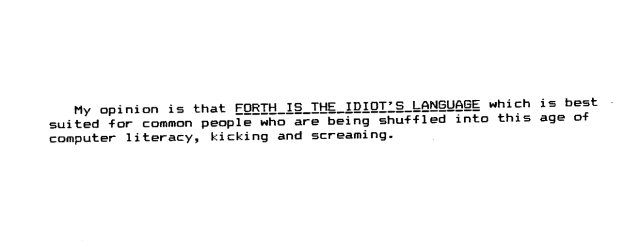
No, no, this book is like a .. early "Learning X for idiots", the author says you don't need to rely on a language's high priests to learn how to do any one thing, the language will enable the average cretin to get where they want to go.
@lritter Relative to 1984 it might be accurate, however. Like BASIC is not really that easy. It's easy to learn but that's not the same as it being easy to do things in.
I have both, but I meant to share this segment when the guest says none of the standard programming languages are appropriate for the end user, not even BASIC.
@mcc the key is datalog. i saw an inkscape in there, a game engine, a database system, the important bit is flattened composition, and a visualizable approach. hard to explain. i go entirely by intuition.
forth shares a weird attribute I also see in scheme: It allows for neat high level DSLs and very abstract code and it's clear that's the intention of the language, but the fundamentals are in some ways even lower level than C
it has "spatiality" which fires a part of my brain that only some 2D cellular automata do, which I find quite interesting from a UX perspective since it's usually not something that we content with in most programming languages.

noah christopher
in reply to Devine Lu Linvega • • •Tor Lillqvist
in reply to Devine Lu Linvega • • •Devine Lu Linvega
in reply to Tor Lillqvist • • •LR
in reply to Devine Lu Linvega • • •Devine Lu Linvega
in reply to LR • • •LR
in reply to Devine Lu Linvega • • •Devine Lu Linvega
in reply to LR • • •LR
in reply to Devine Lu Linvega • • •Devine Lu Linvega
in reply to LR • • •Haelwenn /элвэн/
in reply to Devine Lu Linvega • • •Devine Lu Linvega
in reply to Haelwenn /элвэн/ • • •mcc
in reply to Devine Lu Linvega • • •Devine Lu Linvega
in reply to mcc • • •youtube.com/watch?v=-31sZfPMzw…
- YouTube
www.youtube.comAlgoCompSynth by znmeb 🇺🇦
in reply to Devine Lu Linvega • • •Devine Lu Linvega
in reply to AlgoCompSynth by znmeb 🇺🇦 • • •LR
in reply to Devine Lu Linvega • • •Devine Lu Linvega
in reply to LR • • •I can't wait to see what you come up with! The best contender I've ever come across is still this(fractran): wiki.xxiivv.com/site/pocket_re…
I'm always on the lookout for even more distilled and approachable interfaces for computing.
pocket rewriting
XXIIVVLR
in reply to Devine Lu Linvega • • •Devine Lu Linvega
in reply to LR • • •Oblomov
in reply to Devine Lu Linvega • • •Andy Alderwick
in reply to Devine Lu Linvega • • •thedæmon (Clay Ayers) [he / him]
in reply to Devine Lu Linvega • • •Devine Lu Linvega
in reply to thedæmon (Clay Ayers) [he / him] • • •forth.com/starting-forth/1-for…
Data and the Forth Stack
FORTH, Inc.lhp
in reply to Devine Lu Linvega • • •Devine Lu Linvega
in reply to lhp • • •Kirtai
in reply to Devine Lu Linvega • • •I never thought of that but spatiality does indeed seem to be the thing that attracts me to it. Similar to Smalltalks.
Devine Lu Linvega
in reply to Kirtai • • •