
15 years ago, I co-authored my first paper in the field of #LightPollution studies: doi.org/10.1371/journal.pone.0…
Up to that point, work on artificial brightening of the sky had been done almost entirely by astronomers, who (for obvious reasons) weren't really interested in cloudy nights. But because I was involved closely with ecologists from the Leibniz Institute of Freshwater Ecology and Inland Fisheries @LeibnizIGB, we realized that it's also important to measure the extent to which overcast and clear nights differ.
Through a bunch of twists and turns I now work on #RemoteSensing using nighttime light, but that was the paper that launched me into this direction.
Christopher Kyba 🇨🇦🇪🇺
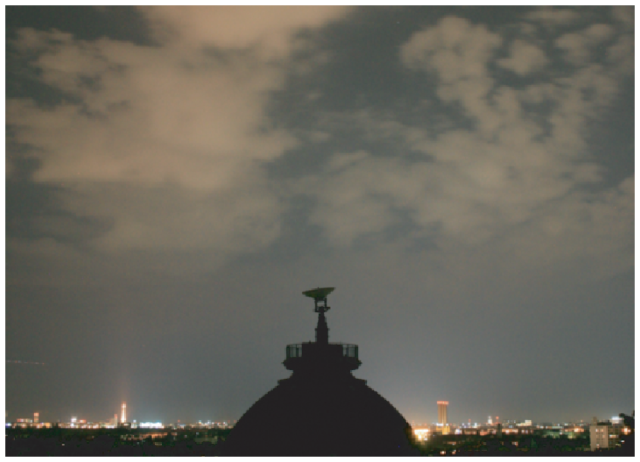
in reply to Christopher Kyba 🇨🇦🇪🇺 • • •Most people in brightly lit countries probably take for granted that clouds are bright at night, but this is completely unnatural. You can see it better in this pair of photos we published in a later paper (titled "Red is the new black"): doi.org/10.1111/j.1365-2966.20…
This probably matters a great deal for nocturnal animals, because it's a reversal of an environmental condition that existed during the hundreds of millions of years that life evolved.
James Endres Howell
in reply to Christopher Kyba 🇨🇦🇪🇺 • • •I teach large university science courses. Hundreds of fairly privileged students in the room. It has been my habit to ask them to raise their hands if they have ever seen the Milky Way.
The results have always been disappointing. Over the past 20 years it has gotten worse and worse. Recently many students don't even know what I mean by the question, and I have to explain what a dark sky looks like.
"Raise your hand if you have ever been awed by a clear dark sky full of countless, countless stars." Always less than 5%.