
"I had indeed wondered how Coleridge could have put so man vivid descriptions of ocean life into his 'Rime of the Ancient Mariner,' given with all the appearance of first-hand knowledge, when the only voyage he had ever made, apart from the trip across the channel, was from Italy to Malta. The answer has been given to us in that remarkable study, almost a detective story, The Road to Xanadu, by John Livingston Lowes...as a subtitle 'A Study in the Ways of Imagination.' With the insight of a Sherlock Holmes, he traces the source of nearly all these descriptive passages. By consulting the old records of the Bristol Library, he was actually able to find out the books borrowed by Coleridge at the very time he was writing 'The Ancient Mariner' and showed that he had read the accounts of many of the voyages of the time, either in separate books or in some of the descriptions given in the Philosophical Transactions of the Royal Society."
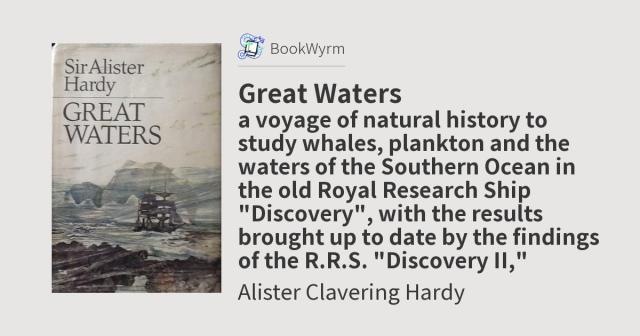
— Alister Clavering Hardy: Great Waters, pp. 95-95
This note is really interesting to me, as an artist using this book as a source of reference material for an artwork about, in part, Hardy's creation of methods to analyse plankton populations. I am also using the library to consult a first-hand report, along with other materials, although I do also hope to collect some plankton in a bay and am working with data scientists and laboratories. I wonder if Coleridge did too.
Lo, thar be cookies on this site to keep track of your login. By clicking 'okay', you are CONSENTING to this.