
I restarted my experiment after having learned lots of approaches that don't work -- specifically I've learned lots of ways to corrode metal, which is not what I want.
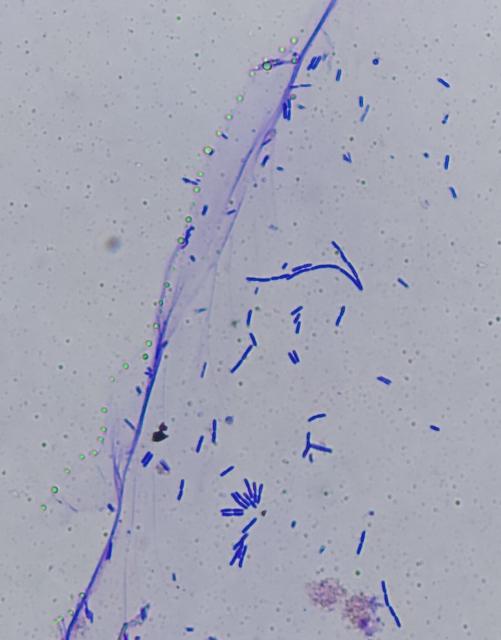
Anyway, I restarted a couple days ago. The negative electrode has developed a cloudy haze around it, which the positive electrode doesn't have. So what's in that haze? Bacteria! Check out this incredible picture. It's so perfect it looks like it came from a textbook!
I'm using 1V DC in a jar of fresh water with 304 stainless steel mesh electrodes, a small pinch of salt, and a small pinch of yeast extract. No aeration.
Danny (he/they)
in reply to Kim • • •Kim
in reply to Danny (he/they) • • •Danny (he/they)
in reply to Kim • • •Kim
in reply to Kim • • •Kim
in reply to Kim • • •This is why you should never drink cloudy water!
This video shows the bacteria in only about 0.001 ml of water from my jar. At the beginning the focus is on the upper plane, and then I slowly move the focus down into the seething mass. This is terrifying. #horror #science #bacteria #OhMyGodWhatHaveIDone
Kim
in reply to Kim • • •#bacteria #science #IttyBittyBees
Kim
in reply to Kim • • •Danny (he/they)
in reply to Kim • • •Kim
in reply to Danny (he/they) • • •@danwchan if anything at all manages to keep growing after reducing the amount of food to zero, then I think of that as success. It means the microbes had to get carbon from somewhere, and I think that's likely to be from co2.
Eventually I'll have to be much more controlled, eg sealed lids to prevent dust from falling in. But I'm not yet at the point where that matters, because so far I haven't gotten anything to grow without carbohydrates or light.