
Jyväskylä in the Sky
Image Credit & Copyright: Harri Kiiskinen
apod.nasa.gov/apod/ap240125.ht… #APOD

APOD: 2024 January 25 - Jyväskylä in the Sky
A different astronomy and space science related image is featured each day, along with a brief explanation.apod.nasa.gov


like this

In a country where women's rights are evaporating, it is hardly surprising that Hollywood follows that trend by further disempowering women. Barbie may not deserve to win various Oscars, but it certainly deserves to have more nominations: in particular for best director. What Barbie had to say was important, and unsurprisingly uncomfortable for the people who enjoy benefitting from a world where others are forced into subservience.
Oscars nominations 2024: Ryan Gosling ‘disappointed’ after Margot Robbie and Greta Gerwig snub
Happy Kending: why righteous anger might be the role that wins Ryan Gosling an Oscar
Gosling’s statement of disappointment about the lack of nominations for Barbie colleagues Greta Gerwig and Margot Robbie is honourable, earnest – and a total masterstrokeStuart Heritage (The Guardian)
like this


Lutris And The Steam Deck
Lutris has been around for a very long time but when the Steam Deck came out Linux gaming as a whole got considerably more popular so I was curious what if a...YouTube
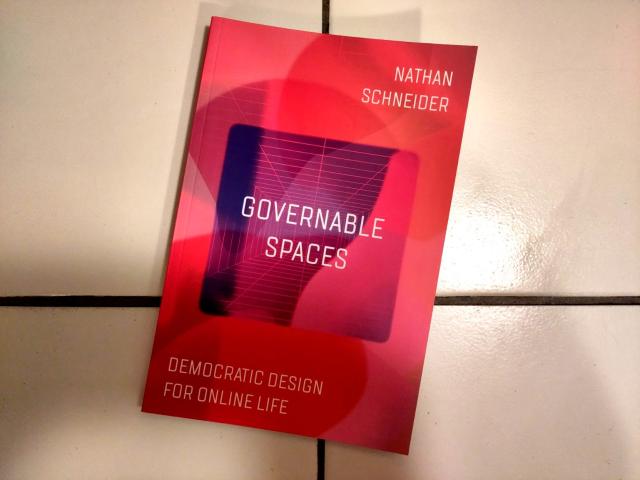
Just found this @ntnsndr and it's so positive ✅️
archive.org/details/25-09-45_-…
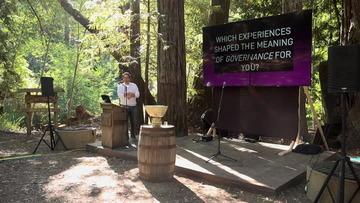
What should community governance feel like? : Nathan Schneider : Free Download, Borrow, and Streaming : Internet Archive
In addition to introducing two projects people can get involved in, this talk will invite participants to rethink their assumptions about how power should flow...Internet Archive
This Saturday I’m excited to meet families at PBS Kids Day in Michigan!
I’m going to be talking to attendees about how oils are “hydrophobic” aka water-fearing with a fun demo where children can squirt colored water droplets into a glass of oil.
If you want to try our experiment with little ones (or adults!) wherever you are, here’s an easy at-home version: funlearningforkids.com/oil-wat… #science #art

Oil and Water Science Exploration
We're definitely adding this oil and water science exploration to our growing list of science experiments for preschoolers.danielledb (Fun Learning for Kids)
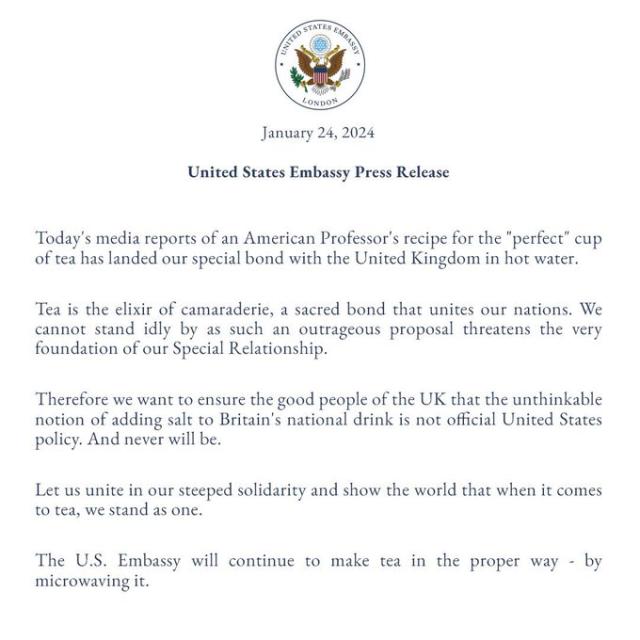
HILARIOUS!
‘Outrageous’ tea recipe involving pinch of salt draws US embassy comment
"The special relationship between two G7 countries has possibly been imperilled by an American scientist’s claim that Britain’s favoured brew requires a pinch of salt.
"The international incident was triggered when a scientist from the US claimed to have found the recipe for a perfect cuppa. The secret, according to Michelle Francl, a professor of chemistry at Bryn Mawr College, is a pinch of salt – and energetic squeezing of the teabag.
"'You get some awful cups of tea in the US. People here often use lukewarm water straight from a tap. It’s horrific,' said Francl, who analysed research papers and ancient texts dating back more than 1,000 years, documenting these experiments in her new book, Steeped: The Chemistry of Tea."
‘Outrageous’ tea recipe involving pinch of salt draws US embassy comment
American chemist inspires moment of diplomatic levity with controversial brewing suggestionsAmelia Hill (The Guardian)
like this
I tend to drink tea without adulteration, maybe some honey and lemon for medicinal purposes. Coffee black.
The 'fringe' coffee and tea beverages I can skip, always. 'Bulletproof coffee' is one.


like this
@ntnsndr @Stacco @alannairving @mattcropp
Strongly agree with Alanna Irving's take (unsurprisingly - she's consistently one of the most thoughtful people about online collaboration). Sharing here for emphasis:
"They are excited by the parts of the problem that are quantifiable or cryptofiable and forget that the important or hard parts of the problem (building trust, connecting your vision with the outside world) aren't quantifiable at all."
@shauna I agree, absolutely, and have long tried to make that point as well (and have tried to learn as much from Alanna as I can along the way!):
plough.com/en/topics/justice/s…
americamagazine.org/politics-s…
But to me the biggest challenge the co-op movement faces is not our ability to build relationships and trust. We're good at that. Our biggest challenge is quantifiable: we are up against systems with way more money and power.

An Economy for Anything
Nathan Schneider on cryptocurrency. What if, instead of storming the kingdom of high finance, we set out to make networks where money matters less?Plough
@shauna Yeah, what kind of power? And is it power you could wield without it corrupting you? Police and military power, to jail and kill opponents? Amassing private luxury to distribute to cronies? Such power is effective in blocking popular change, but it can't help us.
What is money good for? Helping people cooperate across time and space without directly interacting. Doing that without money is hard, but saving the planet with money may be impossible.
@skyfaller @shauna I like your framing of the problem as "Helping people cooperate across time and space" (not sure about the directly interacting). But two things:
Yes, money is quantifiable, and as long as that drives access to building institutions it matters. When money became available to co-ops through US law in rural electricity, credit unions, and agriculture, co-ops became significant shapers of those sectors. Elsewhere, co-ops remain marginal.
@skyfaller @shauna I long for the day when we don't see these questions as black/white, good/bad, but are able to explore the possibilities of any infrastructure both creatively and critically. I really dislike having to be a defender of blockchains, which I have actively criticized since before most people knew about them. But I don't understand the urge to write them off entirely.
Thanks, friends. I am grateful for y'all.
@skyfaller @shauna
Maybe someday we'll all be able to see the good side of MLMs too. It's a real shame that people are so down on them, just because they aren't perfect.
Seriously though, critiques of blockchain technology get met with philosophical arguments about the nature of money and claims about the technology that don't stand up to scrutiny. What I don't seem to get is specific responses to specific critiques.
@skyfaller @shauna
Like, it would be super cool to one day actually have someone prove their contention that blockchains are decentralized. Decentralization may be great and all, but the blockchains aren't decentralized, so...
blog.dshr.org/2023/11/decentra…
blog.dshr.org/2023/02/economic…
blog.dshr.org/2022/01/another-…
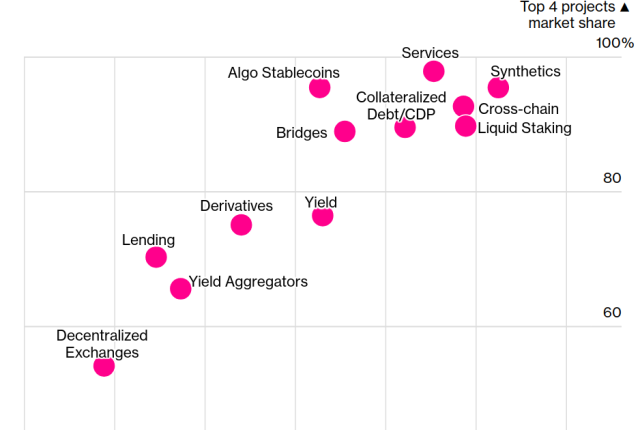
Decentralized Finance Isn't
A major theme of this blog since 2014's Economies of Scale in Peer-to-Peer Networks has been that decentralized systems aren't, because eco...blog.dshr.org
this is in some respects a red herring in my view. Like Walch, I have published criticisms of the "decentralization" claims: ntnsndr.in/Decentral
No system can be fully "decentralized." Generally what appears to happen is new infrastructures, including blockchains, simply trade one form of centralization for another.
That said, most large crypto projects are incredibly deceptive about their "decentralization," yes.
@skyfaller @shauna In #TransforMap times, we liked to talk about polycentric topologies. Berlin is one such example of a polycentric network of many towns and villages combined in one entity, the city.
Also store-and-forward protocols like SMTP or LoFi.Re remember us that maybe we are talking about different combined degrees of centrality instead. AFAIK P2P discoverability in planet-scale P2P networks remains unsolved.
@skyfaller @shauna The same could be said about the fediverse, for instance: fedidb.org/
The aspiration of decentralization, and the tech to support it, will not produce decentralization without economic and policy designs that resist consolidation.
Which is actually precisely the point of the report being criticized—we are seeking economic policy more conducive to distributed ownership.
@skyfaller @shauna Josh, can we name three specific critiques that are missing a response in this thread?
I'm with you about scrutiny in empirical argumentation of the subject.
From the above discussion, I'd pick:
1. Distributed ledgers are not decentralised in terms of protocol design and P2P bootstrap.
2. Philosophical arguments about novel governance and renumeration schemes ignore the fundamental critique of immutable, ungovernable protocol design.
3. The identification and naming of quantification as institutional governance model, which is used to enscribe and reproduce monetary power hierarchies within a private property narrative that encloses common resources, limits the discourse within groups and the public plus assumes and presents social stratigraphy as an ontological fact.
@yala @skyfaller @shauna Thanks for attempting to distill this!
FWIW, my major paper on "novel governance and renumeration schemes" was also a direct attack on "quantification as an institutional governance model": ntnsndr.in/Cryptoecon
And guess what? One of the most prominent people in crypto agreed. twitter.com/VitalikButerin/sta…
Maybe the point is this: One can engage in exploring coalitions and building solidarity while also critiquing one's coalition partners.
@skyfaller @shauna Thanks for mirroring the arguments. As I might feel tempted to answer to the second example later, I'm inclined to offer a slight variation of the prior:
Nobody accused anyone of lying above, if I'm not mistaken, which might leave us with the following, instead:
"The techno-social architecture of distributed ledgers is not sufficient to redistribute wealth equally to all, why we must choose to abandon this and persue other prospects."
@yala @skyfaller @shauna Fair question! Though I do think there are aspects of decentralization and trust-reduction in these systems, but anyway... 😀
- Enabling "virtual co-ops" (like Social.coop) with international memberships, which territorial law often makes very difficult
- Exploring forms of shared ownership through creative tokenization not available through common stock or LLC designs
- Online governance systems that are resistant to manipulation
@yala @skyfaller @shauna More:
- Enabling inroads for cooperative culture and values into an emerging, young, and disenchanted set of subcultures
- Experimenting with mechanisms for financing cooperative projects not available in an investor-centric policy environment
- Exploring novel governance designs that assume online-first communities
- Exploring novel economic incentives designs in the tradition of cooperative dividends that support trust and solidarity
@yala @skyfaller @shauna
-Well we've somehow managed thus far without any need for crypto, right? MyCoolClass has members all over the world without need of crypto, so I think we're already enabled (without paying gas fees).
-This sounds like a legal risk to me, ex an SEC ruling.
-You can do this with permissioned blockchains that do not share the flaws of permissionless blockchains, and are tens of thousands of times cheaper to run. (blog.dshr.org/2023/02/economic…)

Economic Incentives
Economic incentives are the glue holding the cryptosphere together. The security of Proof-of-Work blockchains depends upon the cost in hard...blog.dshr.org
@yala @skyfaller @shauna
- We can talk about MyCoolClass offline
- Legal risk, yeah, so is lots of solidarity work. But that's why the whole point of the report is policy advocacy for shared ownership innovation
- Permissioned blockchains may help in some cases. A favorite example of mine was the "proof of cooperation" of FairCoop. But just as co-ops need dollars and legal shares, sometimes you need an interface with the wider, non-permissioned world
I'll grant you that, but as SBF and others have been finding out, you can't just use blockchain to avoid having to deal with national laws and regulations. Creating a legal framework for int'l co-ops needs to happen, but that in no way means crypto is a good (or legally safe) solution.
I have to take issue with that last statement. The vast majority of the report is talking about how to apply DAO tooling to co-ops to supposedly make them more competitive. The space devoted to that far outweighs the space you all devoted to policy proposals. The summary gives a good idea of the amount of space devoted to each. "Shilling tech" are your words, not mine, but I do think that's a pretty fair description of the bulk of the paper.
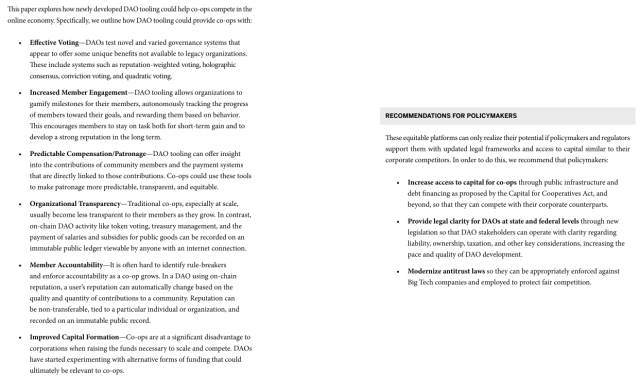
That's fair. I would have liked to see more emphasis on the policy strategies than on the tooling issues.
From my perspective the overall purpose of the report was the policy. It came out of a policy-focused event. But I can see now how it looks like the emphasis is elsewhere.
@yala @skyfaller @shauna
Another critique that hasn't even been addressed in this thread is that tech solutions favor the tech savvy and put everyone else at a disadvantage. While anyone who can read can, with a little effort, understand a set of bylaws, in order to read a smart contract you have to learn to code. Again, no one has actually ever addressed this point.
There is absolutely truth to this. This is why, for instance, I ran a cohort process precisely focused on supporting less tech-savvy communities in exploring this kind of tech: colorado.edu/lab/medlab/2023/0…
But if that's the critique, why are we on the fediverse right now? Should we give up on any technology that involves some early-adopter friction?

> why are we on the fediverse right now? Should we give up on any technology that involves some early-adopter friction?
Part 1 of 2:
I think the principle contradiction now (if you go along with that term) is the capitalist economic system. It is behind all of the other oppressive contradictions.
So I think we need to organize a better economic system that will need to start with local experiments that join together.
@skyfaller You wrote:* "I really dislike having to be a defender of blockchains, which I have actively criticized since before most people knew about them. But I don't understand the urge to write them off entirely."*
People argue their differences rather than their similarities. I actually have a fondness for DAOs, In an already-socialist world they'd be a fun way to experiment. But under capitalism, they enforce the status quo more than challenge it.
@skyfaller I also have a deep resentment of anything like technosolutionism. Over and over I've seen the people who push for tools or quantification to solve a problem be rewarded by capitalism with investment, grant funding, prestige. Over better efforts.
I was a developer advocate once. I barely wrote code - I was mostly using interpersonal/project management skills. Guess what got me the high salary, though? Which skills were listed as requirements?
@shauna @skyfaller I am with you on technosolutionism, I hope! I mean, interestingly: The report being initially criticized here is not actually about technology, it is about building policy coalitions to achieve what the tech can't achieve on its own.
Many socialists also make that same critique of co-ops: Under capitalism, they will just be capitalist stooges.

hello all! I don't know enough to add anything, but just wanted to say it was nice eavesdropping on this conversation 🙂
And yes, too often we end up focusing only on the measurable, because they can be measured and forget about everything else 📐
@skyfaller @shauna
Maybe I could agree somewhat if blockchains were what they claim to be (and what you claim them to be), i.e. decentralized, anonymous, immutable. But in practice they are none of those things, which you must be aware of, right?
"the common meaning of ‘decentralized’ as applied to blockchain systems functions as a veil that covers over and prevents many from seeing the actions of key actors within the system." ~Prof. Angela Walch
I've talked to a lot of people making co-ops irl, and the major issues they talk about nearly all revolve around building trust and relationships in one way or another. I don't think I've talked to anyone, actually, who's told me their major issue in starting a co-op was finding money.
Bingo. This is also a criticism of a lot of the "platform co-op" space - they focus on the tech too much and the cooperative culture aspects (almost) not at all.
I don't know where to begin.
But, for instance, that quote is coming from Alanna, who is herself a veteran leader of several cooperative platforms and a major voice in the movement.
Your comment erases the incredible work of many people in our movement.
@shauna I might also share the intervention of the DWeb Principles (and related camps and events), led by @mai (and which I contributed to a bit). This is an example of work focused on centering "decentralization" efforts around culture, not tech solutionism: getdweb.net/principles/
So many more examples, many of them just part of my daily life and that of my comrades.
Post doc position at Univ of Oslo on Plankton
Through EU Horizon Marie Skłodowska-Curie Action 18 post-doctoral positions (3 years) are available at the University of Oslo (UiO).
Looking for potential candidates interested in building an application within "ONEPlankton - interconnecting methods for high-throughput phytoplankton diversity" research area.
Deadline: 4th April 2024
Starting date: Oct 1, 2024
ONEplankton: uio.no/dscience/english/dstrai…
Applications: jobbnorge.no/en/available-jobs…

ONEPlankton - interconnecting methods for high-throughput phytoplankton diversity and abundance - dScience – Centre for Computational and Data Science
Read this story on the University of Oslo's website.www.uio.no
2024:

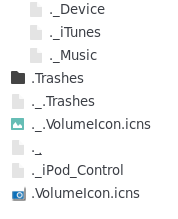
i know that nobody else is going to care.
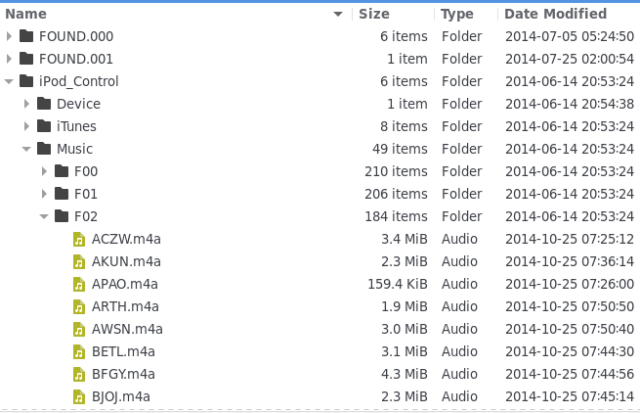
but what is up with the file structure on the second generation ipod shuffle.


NASA Sets Coverage for Northrop Grumman Cargo Space Station Mission - NASA
NASA, Northrop Grumman, and SpaceX are targeting 12:29 p.m. EST on Monday, Jan. 29, for the next launch to deliver science investigations, supplies, andNASA
one day i'm gonna end up forgetting what that weird file called "insecurity" in my documents folder is about
then i'll open up and it'll be like


Therapy Gecko: The Internet’s Unofficial Therapist
During the pandemic, Lyle Drescher started dressing up as a gecko and doing a live call-in show as Lyle the Therapy Gecko. Dresckottke.org
"why are windows registry files called hives?"
literally because they wanted to be a dick to a guy who was scared of bees
devblogs.microsoft.com/oldnewt…

Why is a registry file called a "hive"? - The Old New Thing
Useless trivia day. Why is a registry file called a “hive”? Because one of the original developers of Windows NT hated bees. So the developer who was responsible for the registry snuck in as many bee references as he could.Raymond Chen (The Old New Thing)
@thufie
yeah microsoft likes to rewrite the MSDN blog website every few years and break every single link
here's a new one: devblogs.microsoft.com/oldnewt…

Why is a registry file called a "hive"? - The Old New Thing
Useless trivia day. Why is a registry file called a “hive”? Because one of the original developers of Windows NT hated bees. So the developer who was responsible for the registry snuck in as many bee references as he could.Raymond Chen (The Old New Thing)
This is quickly becoming one of my favourite games, I absolutely adore NEO #TWEWY so let's get back to it
youtube.com/watch?v=gcvNHE8uD5…

【NEO TWEWY】Keep one's eyes peeled
Tip: https://streamelements.com/brodieongames/tipPaypal: https://www.paypal.com/paypalme/BrodieRobertsonVideoPatreon: https://www.patreon.com/brodierobertson...YouTube



A virus that infected animals hundreds of millions of years ago has become essential for the development of the embryo
All animals have evolved thanks to the fact that certain viruses infected primitive organisms hundreds of millions of years ago. Viral genetic material was integrated into the genome of the first multi-cellular beings and is still in our DNA today.Science X (Phys.org)
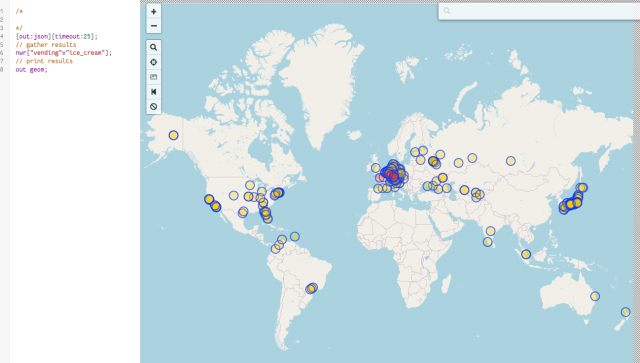
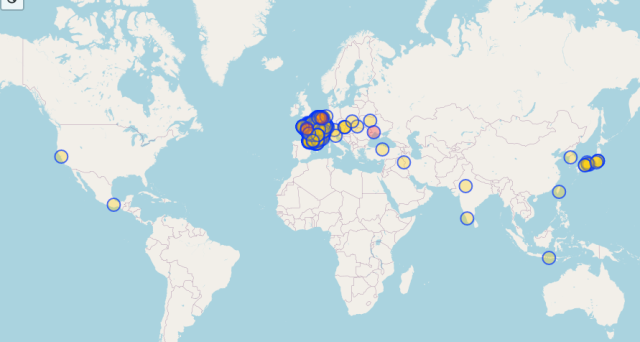
@operand They seem very French and Belgian, though there is one in a mall in San Francisco and it’s called Le Bread Xpress
overpass turbo
A web based data mining tool for OpenStreetMap which runs any kind of Overpass API query and shows the results on an interactive map.overpass-turbo.eu

This new Humble Bundle has some great Soulslikes gamingonlinux.com/2024/01/this…

This new Humble Bundle has some great Soulslikes
Need a challenge? Like Soulslike games? Check out the latest Humble Bundle that has some quality picks in it.Liam Dawe (GamingOnLinux)

NASA, Sierra Space Invite Media to See Spaceplane for Cargo Missions - NASA
As part of NASA's efforts to expand commercial resupply in low Earth orbit, media are invited to view Sierra Space’s uncrewed commercial spaceplane ahead ofNASA
"Saratov Meteorite Thin Section."
Solar Anamnesis, CC BY-NC-ND 2.0 via Flickr: flic.kr/p/2jdauit

Saratov Meteorite Thin Section - Gigapixel
L4 Visible Light Zoom: 4x/0.25 Objective Nikon Z6 LMScope Zerene Stacker GIMP Picture Window Pro Imagemagick digiCamcontrol Full screen gigapixel krpano viewer: cdn.solaranamnesis.com/ThinSections/krpano/saratov-2/Mete... Gigapan mirror: gigapan.Flickr
Solar Anamnesis reshared this.
"CW Tauri by Adam Block data acquired by Josep Drudis."
Adam Block/Mount Lemmon SkyCenter/University of Arizona, CC BY-SA 4.0, via Wikimedia Commons.

"Inside the Great Carina and Keyhole."
Harel Boren, CC BY-SA 4.0, via Wikimedia Commons.


NVIDIA 550.40.07 Beta driver released with fixes for VRR and Wayland
NVIDIA has today launched the 550.40.07 Beta driver for Linux which includes numerous important fixes, so you might want to jump in and give this one a thorough gaming test.Liam Dawe (GamingOnLinux)

NASA, Sierra Space Invite Media to See Spaceplane for Cargo Missions - NASA
As part of NASA's efforts to expand commercial resupply in low Earth orbit, media are invited to view Sierra Space’s uncrewed commercial spaceplane ahead ofNASA
"The Dark Clouds of IC4603 4604 4605 in Rho Ophiuchus."
Dylan O'Donnell, deography.com, CC0, via Wikimedia Commons.

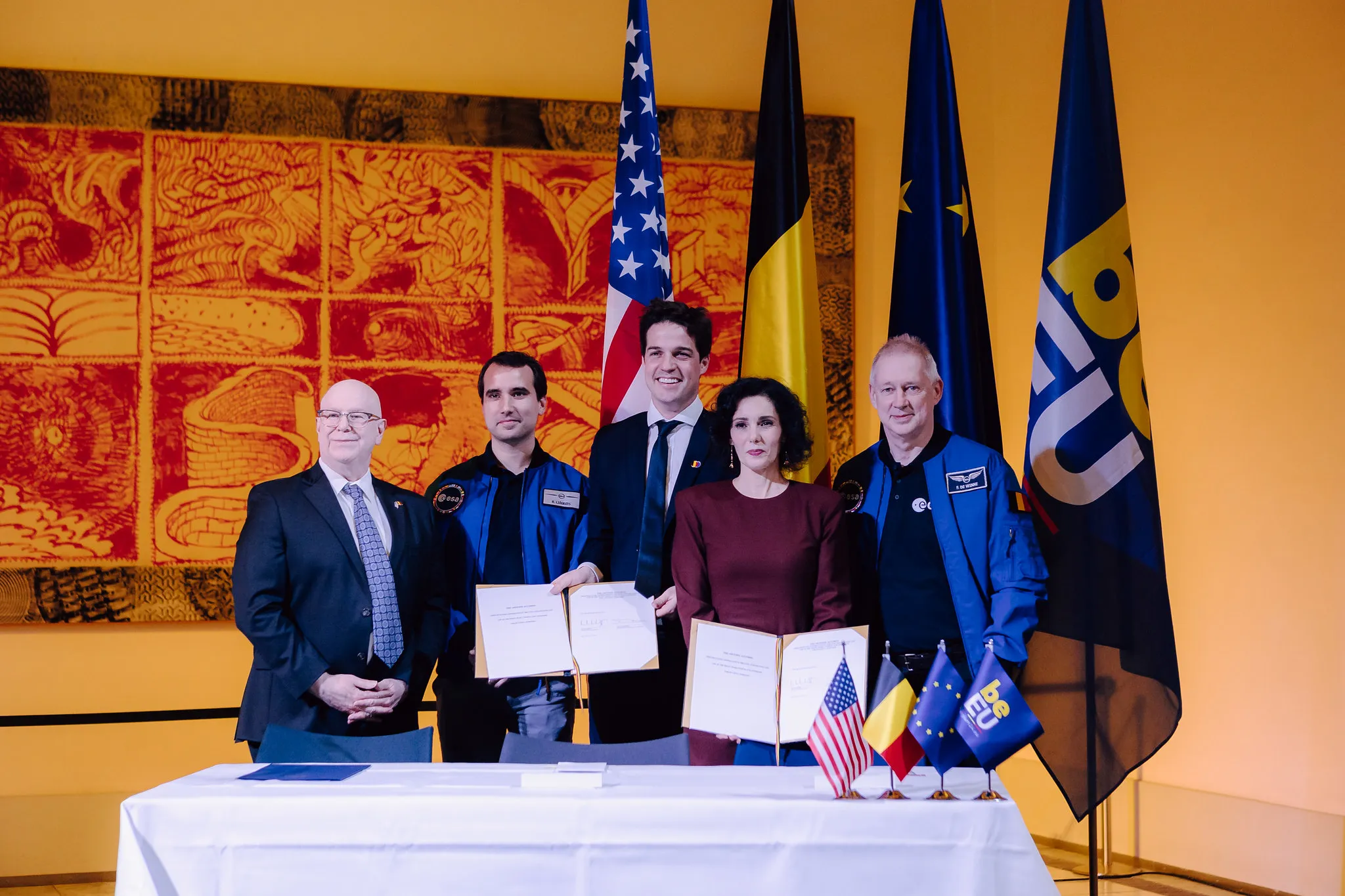
NASA Welcomes Belgium as Newest Artemis Accords Signatory - NASA
During a ceremony at the Museum of Fine Arts in Brussels on Tuesday, Belgium became the 34th country to sign the Artemis Accords. The accords establish aNASA

Celebrating NASA's Spirit and Opportunity Rovers’ Mars Landings - NASA
NASA’s twin rovers, Spirit and Opportunity, stand on the Martian landscape in this poster created to commemorate their 20th landing anniversary.NASA
"Arc of the Galaxy."
John Fowler from Placitas, NM, USA, CC BY 2.0, via Wikimedia Commons or Flickr: flic.kr/p/26zRu9Q

Arc of the Galaxy
Galaxies are not curved, as ours appears to be in this image; they are more or less flat or rounded discs in space. The curved appearance results from perspective and other distortions created by the compression from a wide-angle lens.Flickr
🎙️Welcome to the latest Nextcloud Podcast episode!
Brent chats with Julien about his journey from a community contributor to a Nextcloud team member. Tune in and discover how his app saved a user's family in an emergency, and dive into a philosophical exploration of the AI landscape. Julien's profound ideas are a must-listen!
#softwareengineer #opensource #developer
nextcloud.com/blog/nextcloud-p…

The Nextclouder's Journey with Julien Veyssier - Nextcloud
In this episode of the Nextcloud Podcast, Julien Veyssier shares his unique journey from prolific Nextcloud community contributor through joining the Nextcloud team as Software Engineer.Nextcloud
Chancerubbage
in reply to (moving) APOD • • •even odder- the streets appear to be a Mobius strip.
I thought it was an Aurora image